-
I really like it when people post their ‘redesigns’, like this one, and take you through the rationale that they’ve used in making changes to the layout.
-
Kathy Sierra is at it again – making user experience design interesting and FUN not braindead boring.
Author: Leisa Reichelt
the challenges of migrating & good experience design
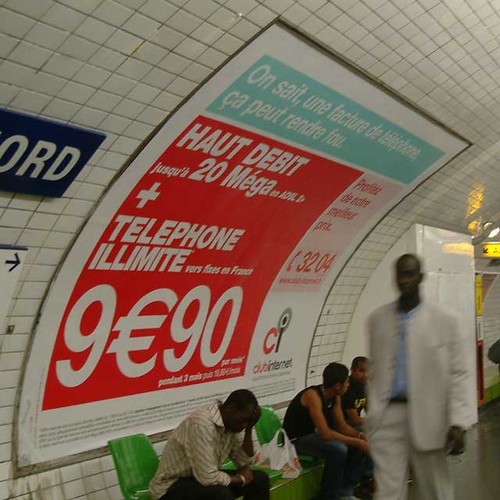
A funny thing happens when you migrate to London. You lose your past. Or at least so it seems in many situations. Try to lease a flat to live in and you’ll need six months credit history in the UK and references from UK landlords. Real Estate agents are legally required to pay no heed to credit histories from other countries, or lovely references from your last landlord. They just don’t count. You can, however, pay 6 months rent in advance to secure a flat. (Yes, that’s six months… crazy stuff).
Try getting a bank account, and again, there is a legally required disposition to regard you as a potential money launderer and/or terrorist, unless you can show evidence of residence in the UK – preferably in the form of a drivers license, or a utility bill. Neither of which you will get without a flat that you own or rent, which you’ll probably not get without a bank account.
Want a mobile phone – for the first six months you’re pretty much stuck with ‘pay as you go’ – unless you can find a nice mobile phone dealership who are willing to be flexible with the truth. You’ll need a bank account and credit record here too. Even then they might require you to pay a large deposit.
I’ve been trying to get broadband on at home recently (you can get 8Meg broadband over here – I’m dying to try *real* broadband!). Of course, all the same problems are repeated and I’m being treated again like a person with a dodgy credit record until – amazingly and completely out of the blue – a man from TeleWest (who I’m trying to get my connection with) calls me and says that he specialises in looking after people who have just moved to the country and I’m to send him a copy of my *Australian* bank statement to prove my previous *Australian* address and he’ll look after my application and get me connected as soon as possible.
*massive sigh of relief*
We’ve been here almost a month now, trying to get our lives set up, and we did some research in advance to help make the bank situation not quite so dire as it might be, but it’s still been an informative experience.
I couldn’t find any stats on how many people move to London every year, but it must be tens of thousands. Tens of thousands of people having this terrible experience every year. I doubt it’s much better in other cities either.
Now, I know that there are issues that go well beyond ‘good experience’ that form the background of some of these examples, but this is no reason to just shrug our shoulders and say ‘well, that’s just the way it is’. These challenges create great opportunities for companies who are interested in good experience to differentiate themselves and capture market share (as well as making some stressed out people very happy!).
Creating good experience is a state of mind. Instead of seeing roadblocks like these as a reason to wash our hands of the responsibility for good experience, we should sit up, gather around, and workshop ways that we can turn bad experience to good.
It’s true for ‘real life’ experience like London banks and telcos, and it’s true for us as we design good experience online. Except instead of money laundering, consumer credit acts, and money laundering concerns, we have dodgy technical environments, aging hardware, and marketing departments.
It’s a challenge, yes, but that’s why we love it :)
Do you have any good ‘online’ examples where you (or others) have overcome a potential roadblock like this to achieve, against all odds, a good user experience?
Photo Credit: Phlzy at Flickr
links for 01 August 2006
-
a great overvlew of tools and things to consider when you’re doing remote usability testing
-
This is one of those articles that you *know* you’ll need to find again to explain to a client why links don’t *always* have to be underlined (as long as you’re consistent)
links for 29 July 2006
-
Written to help you design through ‘the worst of times’ this article actually provides some great advice for anyone doing design work to stick to ALL the time!
-
some great presentations on user research undertaken by Nokia
-
Product complaints and returns are often caused by poor design, but companies frequently dismiss them as “nuisance calls,” – most of the flaws found their origin in the first phase of the design process — product definition.
-
Now this is a bandwagon I’ll jump on – designing with the ‘whole’ user in mind (not just goals, tasks etc). “take a hike, task analysis! Good bye, user goals! These concepts are insufficient for the new kinds of systems we are designing.”
-
“People who understand the social interactions between people and the technologies they use to mediate the interactions need to understand the focus is on the social interactions between people and the relationship that technology plays. It is in a sense