I find myself talking about Twitter quite a lot. I’m not the only one. The behaviours that Twitter has made more visible are tremendously interesting.
I’ve been using a term to describe my experience of Twitter (and also Flickr and reading blog posts and Upcoming). I call it Ambient Intimacy.
Ambient intimacy is about being able to keep in touch with people with a level of regularity and intimacy that you wouldn’t usually have access to, because time and space conspire to make it impossible. Flickr lets me see what friends are eating for lunch, how they’ve redecorated their bedroom, their latest haircut. Twitter tells me when they’re hungry, what technology is currently frustrating them, who they’re having drinks with tonight.
Who cares? Who wants this level of detail? Isn’t this all just annoying noise? There are certainly many people who think this, but they tend to be not so noisy themselves. It seems to me that there are lots of people for who being social is very much a ‘real life’ activity and technology is about getting stuff done.
There are a lot of us, though, who find great value in this ongoing noise. It helps us get to know people who would otherwise be just acquaintances. It makes us feel closer to people we care for but in whose lives we’re not able to participate as closely as we’d like.
Knowing these details creates intimacy. (It also saves a lot of time when you finally do get to catchup with these people in real life!) It’s not so much about meaning, it’s just about being in touch.
As Ian Curry at Frog Design writes:
It’s basically blogging reduced to what the Russian linguist Mikhail Bakhtin called ‘the phatic function.’ Like saying “what’s up” as you pass someone in the hall when you have no intention of finding out what is actually up, the phatic function is communication simply to indicate that communication can occur. It made me think of the light, low-content text message circles Mizuko Ito described existing among Japanese teens – it’s not so important what gets said as that it’s nice to stay in contact with people. These light exchanges typify the kind of communication that arises among people who are saturated with other forms of communication.
I came across this research when I was doing my Masters a few years back and it’s continued to fascinate me (and yes, I’ve been thinking about it quite a bit whilst considering, and defending, Twitter).
Here’s an observation from some Japanese ethnographic research into the use of camera phones by young people undertaken by Daisuke Okabe (2004):
intimate sharing / presence sharing intimate photos on the handset when talking face to face with people. Photos that fall into this category would be photos of partners, family, pets, etc. However, this can also be very every day stuff eg. what I’m having for dinner. It is sharing ongoing mundane visual information with intimates, creating a sense of presence in other peoples lives without needing to talk or be physically present.
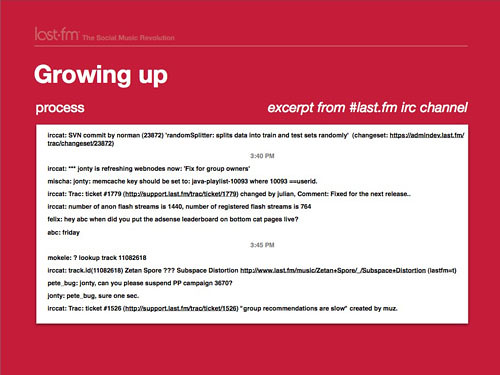
I think that the simplicity of Twitter is key to it’s success. The messages must be short and they’re simple text. I’m starting to think that the level of stimulation is key to the success of these ‘osmotic’ communications (as the guys from LastFM referred to the IRC channel they use internally).
We’ve been trialling some options for a similar kind of osmotic backchannel to use at Flow. One of the first things we roadtested was Skype Public Chat. Amongst some other problems (including that there is no Mac version of the current release which supports the Public Chat function), it seemed that the flashing and noises and animated emoticons were too stimulating… the conversation wanted to leap to the front of the screen continually demanded attention.
IRC on the other hand (ah, what a flash back to open up mIRC again after all these years!) reminds me a lot more of Twitter. There’s none of the flashing and animating and carrying on. The humour is in the text (it took about 30 seconds for the first trout related comment to emerge… old habits…). To me, IRC seems to be a much more effective tool for a back channel, for supporting this osmotic communication within a company. (Assuming we can reduce the barrier to ‘log on’… it’s not a friendly experience for not-geeks).
What does seems clear is that, for a lot of people, this ambient intimacy adds value to people’s lives and their relationships with others. I think we can expect to see a lot more of it… but if I was building a tool to support it, I’d be keeping it very simple and unobtrusive. Osmosis is one thing, hyper-stimulation is quite another!
Image credit: Slide used by LastFM in their presentation at FOWA
Reference: Okabe, Daisuke 2004, Emergent Social Practices, Situations and Relations through everyday camera phone use, presented at Mobile Communication and Social Change, the 2004 International Conference on Mobile Communication in Seoul, Korea, October 18-19 2004
Interesting post. I have lately been trying to recall in great detail what life was like before all this technology, even before mobile phones, and although perhaps I was too young at the time to make a proper analysis here, I do know that my circle of acquaintances was dramatically lower, because there is only so much time in the day for phone calls and letter writing, which is what we used to depend on. So these technologies have certainly broadened my circle of contacts, although it has also increased the burden of responsibility to keep them relatively close to my life. As you say, this can be quite an enjoyable pastime, and its interesting to observe the growth in tools that facilitate this ‘feeding of acquaintances’.
For me, Twitter is excessive. A real Big Brother. I don’t care if a friend is taking a shower or eating sushi. But I care of what he thinks about my interests and I appreciate if he likes what I’m writing on my blog. So, I prefer MyBlogLog. With it, I know when my australian friend comes to read my thoughts on the last movie I have seen, and I’m in touch with all people I like worldwide and all their friends sharing common interests. :-)
[…] But I think the app can have some real utility, above and beyond ambient intimacy. So I am looking for 1000 followers to the RedMonkRSVP twitter id. The idea is that we will be able to run instant polls according to our, and your, research ideas. Sort of a lightweight yougov poll. Twitter was never intended for this but I would like to try it and I need your help. Please get people to sign up and lets start twittering the wisdom of the crowds. I don’t have an infrastructure in place to aggregate and query results, but when did that ever stop anyone from achieving cool things? I am hoping that the folks from Adobe will grab the jump ball and build a Flex app to record results from inbound replies (Ted, Duane?) […]
Leisa – nice post. Anil from last.fm here. wrt getting non-technical people using irc – it’s not been a problem for us. We have all our business/labels/design people on the channel too and they can all absorb information from it.
Yuh! Sounds good to me ;) I’m glad more and more people are doing ambient intimacy things, it’s so much fun to consume, publish, and swirl around in.
With respect to IRC, I really wish it was more widely used. Part of the problem is installing a whole new app, but the bigger problem is that many corporate networks block IRC, which totally sucks.
Not to mention that IRC doesn’t work over SMS as Twitter does. I don’t use the txt updates or digests (by sending “get” to Twitter) most of the time, but I love having them when I’m out, about, and bored. A little update to 40404, and I’ve got my fix for producing content!
[…] disambiguity – » Ambient Intimacy This is the best post I’ve read yet on Twitter. Leisa: right on. (tags: twitter relationships networking social) […]
[…] disambiguity – » Ambient Intimacy Anne says this is the best post yet on twitter. i still say its telepathy but citing Bakhtin is always a winning strategy. quite the critical theory day with Bakhtin and flaneurs turning up. I think we’ll see more mashups of critical theory and network ar (tags: criticaltheory Twitter telepathy adoption) […]
[…] Ambient Intimacy “It helps us get to know people who would otherwise be just acquaintances. It makes us feel closer to people we care for but in whose lives we’re not able to participate as closely as we’d like.” Yuh! (tags: twitter socialsoftware ambientintimacy people via:JamesGovernor) […]
[…] There are a wide variety of tools that might be used for workstreaming, and which ones suit you and your team depend both on what kind of work you do and what tools your coworkers are using. It’s not effective to use an IRC channel if you’re the only one on the team who knows what IRC stands for, but it can be great for a techie crowd. Twitter creates a virtual shared office space that can reproduce the chatter and intimacy of a physical office while allowing team members to share what they’re working on and what they’ve completed. RSS feeds from blogs, message boards, photo sites, and project management apps could all provide useful workstreams—especially if these are aggregated for a whole team. Source code control systems like Subversion can output RSS feeds too so you can make team members aware of new features and bug fixes as they’re checked in. […]
“Ambient Intimacy” … I expect to see it gain ground as a catch phrase.
(I also gather, by reading, that it’s not the relationship I was seeking at the bar in town during my college years…)
I love the Ambient Intimacy (beautifully put) of Twitter (and flickr for that matter). I was quite sure that it would annoy me and just be another web thing that I would sign up for and ignore – but it isn’t. There is something charming about little messages from people you know popping up during the day that you are not compelled to respond to. Like the difference between doing a horrible chore all on your or have someone sit with you while you do it – just knowing they are there somehow makes it better.
[…] Leisa Reichelt has coined the term Ambient Intimacy to describe the value of Twittter. For some reason, this turn of phrase really resonates with me. [So, yet another RedMonk recommended blogger enters the 30 day evaluation folder in NetNewsWire…] […]
[…] Leisa has branded this wave of [micro-communication+social openness] as ambient intimacy in this great post. […]
I really like the term “ambient intimacy” since I believe that in the future people will share more intimate details of their life with smaller closed groups of friends, family members, etc, as opposed to the public nature of current “lifestream sharing” services.
At Jaiku, we are aiming towards this with an approach that is slightly different from and complementary to Twitter (quite a few Twitter users have added their Twitter feeds to Jaiku’s lifestreams). We emphasize the ability to ignore the “ongoing noise”, but every now and then there will be a short discussion around a particular update (such as in Stowe Boyd’s lifestream here).
Oh, perfect. I’ve been thinking a lot about this too, and I keep writing long posts about how people are treating Twitter and what it exposes, & that strange intimacy. Blogging functions that way, which is why we all have of “blog-friends” who are closer to us in many ways than people we see regularly in daily life. Twitter does that on another scale, very beautifully.
the peeps over at 30boxes have described their hope for connectedness among “buddies” as “situational awareness”. i like the term…it’s not exactly the same as “ambient intimacy” or how myspace has redefined the word “friend,” but it’s along the same lines.
i’m fully on board with the lifestream concept, and like the ideas you bring up in your post. kudos.
I love it when a blog post captures a concept I had never thought of, yet is all around me. Love the term Ambient Intimacy. I just wonder if as a society we are starting to favor Ambient Intimacy over the deeper, more traditional intimacy that we have had with family and friends. (How old and stodgy do I sound now?)
Marc :-)
[…] disambiguity – » Ambient Intimacy Ambient intimacy is about being able to keep in touch with people with a level of regularity and intimacy that you wouldn’t usually have access to, because time and space conspire to make it impossible. Flickr lets me see what friends are eating for lun (tags: twitter social community relationships ambient flickr sociology web2.0) […]
[…] People ask me what I think of Twitter and whether it’s really important or useful. I’ve already said a bit about it, but here’s a funny story. […]
It’s been proposed (sorry that I can’t dig up the reference) that we humans in our earlier days formed bonds amongst ourselves through mutual grooming and that these grooming circles were limited in size to about 50.
It’s also said that, as we evolved, our hands became far too, well, handy, to fritter away in grooming. So, our ancestors came to maintain their social bonds by inventing speech and yammering at each other whilst they were using their hands to make tools, stir pots, change diapers, whatever.
It turns out, in fact, (again, sorry I can’t dig up the reference) that our conversations are still dominated by inconsequential blather, what some might call “noise.” This noise, as you point out, is ideally suited to maintaining social bonds.
What is interesting about all this is that what with all the twitter posts from mobile phones and keyboards is that we apparently have returned to using our hands to maintain social bonds. Perhaps its because we don’t want to waste our voices on such mundanities.
Last, I would like to know about the numbers of friends that active tweeters follow. How many follow more than 50?
[…] disambiguity – » Ambient Intimacy “Ambient intimacy is about being able to keep in touch with people with a level of regularity and intimacy that you wouldn’t usually have access to, because time and space conspire to make it impossible.” (tags: twitter adoption behaviour ambientintimacy greatterm conversation community social socialsoftware) […]
Twitter, c’est quoi? Explications……
Cet après-midi, je ramasse 20minutes dans le bus, et je vois qu’on y parle de Twitter. Bon sang, il est grand temps que j’écrive le fichu billet en français que je mijote depuis des semaines au sujet de ce service que j’adore (apr….
[…] The primates of Twitter Henry Halff, Larry’s dad, makes a very interesting comment: It’s been proposed (sorry that I can’t dig up the reference) that we humans in our earlier days formed bonds amongst ourselves through mutual grooming and that these grooming circles were limited in size to about 50. […]
LOL @ Twitter as mutual grooming… it certainly is a lot like that isn’t it!
I’ve just noticed that I can’t tell how many people I’m actually following on Twitter at the moment. I have 64 friends at the moment, but that includes things like BBC news and Twitter status updates, which uses Twitter in a slightly different way. And I have some ‘friends’ who I don’t follow (meaning I don’t get their messages via IM or SMS, but still follow on web), in my case either because I don’t know them so well or don’t have so much in common with them, so their updates are less interesting to me, or because they Twitter to much and too often and I can’t handle the noise.
I reckon I probably have about 50 people who I do follow at the moment, and I definitely feel as though I’m at a kind of threshold where I couldn’t really handle much more.
So, that’s a survey of one that fits your hypothesis… anyone else want to share some numbers?
Leisa,
I heart this post. Thanks for all of your great information on Ambient Intimacy. I always felt that way about Flickr, too. I could glean my friends’ current state of mind and activities by their uploaded photos. I think Twitter lowers the barrier to entry even more! :)
Since I asked the question concerning the number followed, I suppose I’d better answer for myself. I beleive that my count is three (3).
That’s such a great phrase, Leisa. I’d been using hive mind, as that is what it felt like to me, however it fails to capture the emotional aspect that ambient intimacy captures. I hope that becomes a permanent term.
[…] E não é que, lendo as mensagens sobre o twitter, em uma das listas de discussão que participo, me deparo com um link para um post com um texto sobre o tal Twitter. Depois de ler o post, vou para a página inicial do blog e vejo o que mais parece um presente: um post que nos lembra o que a Apple faz: paper prototyping e user research. […]
You’ve coined a great phrase, Leisa – best description for Twitter I managed to come up with was “picking lice” – meant in a positive ape-grooming kind of way, just like Henry’s take on it, but it’s not likely to catch on is it? “The latest trend in virtual lice-picking…” ;-)
[…] After several months of Twitter usage, Leisa Reichelt’s characterization of Twitter as Ambient Intimacy still resonates with me. I have some more thoughts on ambient intimacy in the context of Twitter, and I’m going to take them in the reverse order of the catchphrase. […]
[…] Twitter’s Evan Williams is giving and invited talk at ICWSM and just sowed a good quote from Leisa Reichelt. Ambient intimacy is about being able to keep in touch with people with a level of regularity and intimacy that you wouldn’t usually have access to, because time and space conspire to make it impossible. Flickr lets me see what friends are eating for lunch, how they’ve redecorated their bedroom, their latest haircut. Twitter tells me when they’re hungry, what technology is currently frustrating them, who they’re having drinks with tonight. These icons link to social bookmarking sites where readers can share and discover new web pages. […]
[…] Evan also presented a quote from Lisa Reichelt about ambient intimacy that describes Twitter. Ambient intimacy is about being able to keep in touch with people with a level of regularity and intimacy that you wouldn’t usually have access to, because time and space conspire to make it impossible. Flickr lets me see what friends are eating for lunch, how they’ve redecorated their bedroom, their latest haircut. Twitter tells me when they’re hungry, what technology is currently frustrating them, who they’re having drinks with tonight. […]
[…] Ambient Intimacy (tags: twitter social web2.0 psychology relationships) […]
[…] April 3, 2007 at 1:25 pm · Filed under Uncategorized Excellent article about how media and communication sharing services like Flickr, and Twitter are breaking down the barriers of formal communication. Read on to understand and link through to the full article: disambiguity – » Ambient Intimacy Ambient intimacy is about being able to keep in touch with people with a level of regularity and intimacy that you wouldn’t usually have access to, because time and space conspire to make it impossible. Flickr lets me see what friends are eating for lunch, how they’ve redecorated their bedroom, their latest haircut. Twitter tells me when they’re hungry, what technology is currently frustrating them, who they’re having drinks with tonight. […]
Hi, there is a similar concept in the HCI research field. It is called Intimate Social Networks, many interesting papers have been published on this topic. I participated in a workshop two years ago at CHI about mediated intimacy and ambient awareness systems. The position papers are not available unfortunately but mine is still online http://insitu.lri.fr/~labrune/web.jb/CHI2005_MackayRicheLaBrune.pdf , also about intimate social networks, interesting works done by the interliving project http://interliving.kth.se/
[…] Then today I happened to read this post: Ambient Intimacy, and I really enjoyed it, it really got my brain juiced up… I disagreed with almost every bit of it. The author is one of the “others” — someone who uses it and values it. […]
[…] Ha, I think I finally found the answer to the question: Why do people like to take pictures of their breakfast and put them online? One Leisa Reichelt talks about what she calls Ambient Intimacy, which can be considered a form of copresence. In a nutshell, ambient intimacy is about sharing mundane, everyday things with people we know, in a casual, unobtrusive way, which can create for the consumer a sense of presence and of “being involved”: Through transmission of information about the producer’s environment (images, sound, textual descriptions), a shared “mental” space is established which both the producer and the consumer can relate to. […]
[…] From Disambiguity via loose wire. I have a similar post on hallway conversations (not nearly as nicely phrased) that I will port over this week: Ambient intimacy is about being able to keep in touch with people with a level of regularity and intimacy that you wouldn’t usually have access to, because time and space conspire to make it impossible. Flickr lets me see what friends are eating for lunch, how they’ve redecorated their bedroom, their latest haircut. Twitter tells me when they’re hungry, what technology is currently frustrating them, who they’re having drinks with tonight. […]
[…] With Twitter I can get up to date with my network in less than half an hour – the beauty of the 140 character limit for messages. One of Kathy’s last posts before some thugs scared her off the blogosphere argued that Twitter was Too Good. I am more aligned with Tara Hunt and Lisa Reichelt (Ambient Intimacy). […]
[…] Leisa Reichelt has applied an interesting new term to all of the “twitterness” going on in the valley as of late — “ambient intimacy.” Quoting her: […]
It isn’t quite ambient, it isn’t utilising an otherwise vacant information stream. It doesn’t quite replicate the bustle and noise of an room where you cue in on conversations that interest you without requiring you to glance at another window or grab a phone. It should stream in without conscious effort. Twitter requires some effort.
Having said that the level of intimacy itself is proportional to the number of updates that your friends make. Situational awareness ( as one poster mentioned ) relies upon regular updates. I do care what friends are up to but it takes context and timeliness for those twitters to be relevant. And often it requires following a stream of thought as well.
osmotic is another good word already used, if we could absorb voice twitters in such a way that we don’t disturb the rest of our environment ( workplace party etc ) then it would truly be ambient.
What it does do is foster the shared cultural awareness and shared experiential memories that bonds friends together.
[…] Over time we will begin to see these loose wires meld into a seamless AttentionStream. This won’t happen overnight and I expect we will see other ‘wires’ form in the interim. Ruminating on that I extrapolate that we will see Twitter 2.0 some time soon – the question is what will it look like. What other than reducing blogging to the phatic function will resonate and more importantly, will bring us one step closer to a melded AttentionStream. […]
[…] Un seul exemple parce que j’ai la flemme de chercher plus loin, mais cet argument est régulièrement avancé par ceux qui visiblement n’ont pas pris le temps (vu ce qui précède, je ne vais pas jeter la pierre) de comprendre comment fonctionnent les relations humaines et l’intimité en particulier. Ce sont “les petites choses de la vie” qui font les gens proches. Et l’intimité ambiante qu’apporte Twitter peut aider à garder vivants ou même renforcer les liens distendus par la distance (c’est moche ou poétique, à vous de choisir). Certains l’ont compris: […]
[…] Reboot 9.0 – I’m off to Copenhagen at the end of the month to go to Reboot for the first time. I’ve heard rave reviews of this conference and can’t wait to experience it myself. I’m going to be talking about Ambient Intimacy (in the middle of preparing the presentation right now and *really* enjoying it!) […]
[…] An aside: Leisa Reichelt calls the phenomena Ambient Intimacy – “being able to keep in touch with people with a level of regularity and intimacy you wouldn’t usually have access to, because time and space conspire to make it impossible.” […]
[…] ** And yet another: Lisa Reichelt’s theory of Ambient Intimacy for Twitter digg_url=’http://ubernoggin.com/?p=13′; digg_skin = ‘button’; digg_bgcolor = ‘#FFFFFF’; digg_title = ‘The Exodus from Twitter to Jaiku’; digg_bodytext = ”; digg_topic = ”; Powered by Gregarious (42) Share This […]
[…] Excerpted from a this post by Leisa Reichelt I find myself talking about Twitter quite a lot. I’m not the only one. The behaviours that Twitter has made more visible are tremendously interesting. […]
Excellent post, Leisa, one of many…
(Just came here from Stowe Boyd’s feed and I’m impressed)
Can’t resist giving you and Henry the footnote you are looking for, in comments 20 and 24. It’s a fantastic book on the evolutionary origins of language – quite useful for people who value things like storytelling in design, etc. By the way, the ‘number’ is not 50 but around 150.
Grooming, Gossip and the Evolution of Language, Robin Dunbar. Faber and Faber, 1996. ISBN: 0571173977
For background, see also: http://www.guardian.co.uk/life/interview/story/0,12982,955709,00.html
[…] Don’t know yet. Once upon a time, remember, this was the norm and now that real villages of one kind or another seem to be forming again – my parenting blog definitely lives in a little village of people I’ve never met but who’s everyday rhythm of life is increasingly familiar to me – being immersed in the flow of other people’s lives (I relate this to the concept of ambient intimacy outlined by Leisa Reichelt) is gradually becoming our default state of existence once again. […]
[…] Read on. […]