The redesign project for Drupal.org will be guided by an experience strategy that will inform our decision making in all aspects of the redesign and which will, we hope, be able to be used as ‘a star to sail our ship by’ (as Jesse James Garrett would say) – as a clear objective to design towards.
What is an experience strategy?
An experience strategy is a clearly articulated touchstone that influences all of the decisions made about technology, features, and interfaces. Whether in the initial design process or as the product develops, such a strategy guides the team and ensures that the customer’s perspective is maintained throughout.
– Subject to Change, Creating great products and services for an uncertain world, Merholz, Schauer, Verba & Wilkens (Adaptive Path) 2008
This is a good example of an experience strategy:

How it worked out for Google Calendar:

(hat tip to Peter Merholz for images)
Experience Strategy for Drupal.org (Work in Progress!)
- Drupal.org is for anyone who is interested in Drupal (not just developers!)
- Drupal.org will make building a site you’re proud of as painfree as possible (from deciding to use Drupal through design, development and deployment)
- Drupal.org is the home of the Drupal community.
- UPDATED: Drupal.org is the project management and release tool for the Drupal software (thanks Robert Douglass)
- Drupal.org will support people and companies from their initial experience of the product and community and as they continue to increase their knowledge and experience with Drupal and become more active in the Drupal community.
- Is a showcase for what can be done with Drupal
What we believe:
- Drupal.org is as much (if not more) a social site than a content site
- The Drupal Community is as important (if not more) than the Drupal Product
- The Drupal product is a market leading CMS solution
- The ‘end point’ (goal) is not getting more people to download Drupal, the end point is to get more people to have a Drupal site running that they love (with as little pain as possible)
- Anyone can find out what they need to know about Drupal on or from Drupal.org
- We must flatten the learning curve – anyone can learn as much as they want to learn about Drupal
- Modules are easy to find and evaluate and are an obvious asset to Drupal
- People can see/learn and align themselves with Drupal’s (and Open Source) values…
- Drupal.org is a living organism and, with the help of the community, will continue to grow and improve.
How this plays out

Drupal.org has two equally important audiences – people who are new to Drupal and people who are already part of the community.
Drupal.org needs to inspire and educate people who are new to Drupal – the end goal being that they become active participants in the Drupal community who have a Drupal site (or sites!) up and running that they are proud of.
Note: getting people to ‘download’ Drupal is not the end point. If anything, it’s just the beginning.
Drupal.org also needs to be a comfortable and safe home for members of the Drupal community, wherein participants are both able to develop their own skills and experience (grow up), as well as help others on their developmental path (help grow others up).
Things we need to do:
- be nicer to ‘outsiders’ (non drupal, non developer)
- encourage people to engage with the community (starting by showing them that it exists!)
- work at flattening the learning curve
- get all the right content on the site and keeping it updated
- show the community in action (without ruining it)
- make things findable (IA)
- communicate drupal/opensource values
- help Drupal users kick ass
Getting past the brick wall
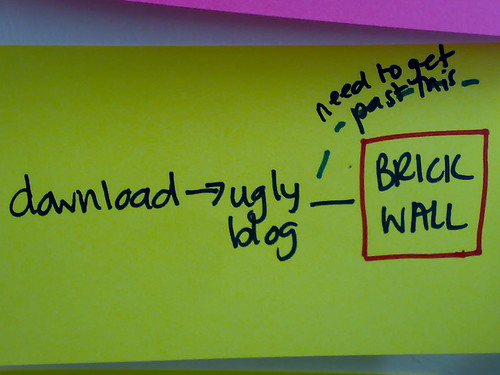
As one person I’ve interviewed described it: ‘I can get Drupal downloaded and installed and get an ugly blog that I don’t want, but then I hit a brick wall’ – Drupal.org’s job is to help people over that brick wall – to help them get the site they want using Drupal.
Helping Users Kick Ass
Bert Boerland pointed me to this great diagram that Dries posted a while back (inspired by Kathy Sierra) which I think really nails a big part of our strategy.

So, that’s what we’re thinking.
Over to you now. What do you think of this as an Experience Strategy for Drupal?
Questions? Comments? Suggestions?
(Remember, there are lots of ways you can point us to things you think are important for d.org)